Essay by Yvonne Low, Nguyễn Thị Minh, Hương Ngô, Astrid Reza, Trần Hoàng Ngọc Thư, Jennifer Yang
Essay | Southeast Asian Women in “Exile”: Re-imagining histories of anti-colonialism, nationalism and feminism
Introduction | Malaysia | Indonesia | Vietnam | A Coda
Introduction
It is with ambitious aims and desires that we seek to trace the lives and work of creative women who performed the role of activists, artists, and intellectuals across Southeast Asia; and whose contributions to anti-colonial, feminist, and progressive movements have been systematically marginalized or erased with few exceptions. While recent scholarship has begun recovering leftist writings from the region — examining figures like Jose Maria Sison, Jit Phumisak and Ahmad Boestaman— our research addresses a critical gap by centering the creative and political work of women whose radical contributions have been doubly obscured by both anti-communist repression and patriarchal erasure within revolutionary movements themselves.1
As we encounter the stories of figures involved in Indonesia’s banned Api Kartini magazine (1959-1964?) and its predecessor the radical anti-colonial feminist journal Sedar (1930-1932), Malaya’s transnational socialist feminist networks, we also follow the lives of Vietnam’s pioneering women. Among them: Sương Nguyệt Anh, editor-in-chief of the short-lived but influential Nữ Giới Chung (1918) and the woman painter Lê Thị Lựu, whose emergence into public life was heralded by the feminist press as a sign of national progress. Across these stories, we observe as well how they navigated colonial repression, post-independence purges, and Cold War surveillance alongside the patriarchal structures that persisted within their own movements, demanding that women sacrifice motherhood, bodily autonomy, and individual rights to prove their revolutionary commitment (Sophie Quinn-Judge, 2002).2 Many were forced into exile, for example their publications banned, their names removed from official records, their organizations scapegoated by authoritarian regimes seeking to consolidate power; their work remains largely unknown and unacknowledged.
The systematic erasure of these women from national histories reveals deliberate mechanisms of suppression that operated across the region, yet took distinct forms in each national context. In Vietnam, this took the paradoxical form of exile through commemoration — where women revolutionaries like Nguyễn Thị Minh Khai (1 November 1910 – 28 August 1941) were celebrated as martyrs while their feminist critiques of sexual coercion, patriarchal control within the party, and demands that women abandon motherhood for the revolution remain suppressed, unable to enter public discourse.3 More common across the region, women’s organizations were specifically targeted precisely because of their dual threat: they challenged both colonial and patriarchal structures while building transnational networks of solidarity that transcended national boundaries.
In the Indonesian case, Api Kartini, the magazine published by GERWANI (Indonesian Women’s Movement) was banned during the New Order Regime and systematically erased alongside the organisation’s subsequent defamation.4 Who is the painter, Siti Halimah, and how was she involved in Api Kartini?5 Even as more about the lives of LEKRA (Institution of People’s Culture) members, Mia Bustam(4 June 1920 - 2 January 2011), Siti Rukiah (25 April 1927 – 7 June 1996) and Sugiarti Siswadi (unknown - 1987), are brought to light with the publishing of memoirs or scholarly essays, Halimah remains almost entirely absent from archival records and published scholarship. It begs questioning how visual artists collaborate with writers and editors to produce a feminist anti-colonial aesthetic — an area that remains poorly studied.6
Figures like Siti Rukiah and Mia Bustam operated within overlapping networks of cultural production and political resistance that cannot be understood through disciplinary silos or the individualist frameworks that dominate conventional art history. The art world of postcolonial Indonesia, as this project seeks to show, encompasses leftist women writers critiquing revolutionary failures, feminist organizers building transnational networks, and cultural workers challenging both colonial and patriarchal structures through publications like Api Kartini.
Why were their stories — till now — suppressed? Writing history from scattered, “forbidden”, and incomplete archives requires confronting difficult questions about memory, access, and reconstruction. What happens when the only traces of entire networks of women activists have been deliberately fragmented — and at times deemed dangerous/deviant?7 The current state of these archives reflects ongoing political stakes — that Api Kartini materials remain scattered and are only recently emerging in digital form suggests continued investment in keeping these histories inaccessible.
The transnational dimension of these movements complicates simple narratives of national liberation. Women like Khadijah Sidek (1918-1982) moved between Sumatra, Malaya, and Singapore; Shen Zijiu (1898-1989) connected Malayan women’s movements to global socialist feminist organizations; Han Suyin (1917-2012) redefined Malayan literature through trilingual publishing that crossed linguistic boundaries. It is within such a political and cultural terrain that an organisation like the Equator Art Society (EAS) also takes on new meaning — emerging not as an isolated local phenomenon but as a parallel expression of this transnational, socialist-oriented cultural movement, sustained by Chinese-educated writers, artists, and activists across 1950s-60s Malaya/Singapore, and equally committed to reflecting the lives and views of everyday people. These networks demonstrate how women activists created spaces of feminist solidarity that transcended the emerging boundaries of post-colonial nation-states in spite of how they may subsequently be viewed as threats to nationalist projects.
This project draws attention not only to individual lives but the patterns of transnational connection, mutual support, and shared struggle that characterized women’s movements across Southeast Asia in the mid-twentieth century — histories in which feminist solidarity repeatedly cut across the dividing lines of race, nation, and formal political affiliation. The following sections examine these histories in greater depth: first, the Malayan socialist feminist networks centered around New Women’s Monthly and the activists who moved through this space and between borders; second, the Indonesian publications Api Kartini and Sedar and the women who created them. Finally, we examine the situation in Vietnam, where patterns of erasure ranged from colonial suppression of early women’s journalism as seen in Sương Nguyệt Anh’s pioneering Nữ Giới Chung (1918), to the postcolonial paradox of exile through commemoration that celebrated women revolutionaries as martyrs while suppressing their feminist critiques, as seen in the trajectories of figures like Lê Thị Lựu (1911-1988). Together, these case studies highlight the deliberate erasure of radical political and artistic legacies while demonstrating the persistence of these histories now emerging through digital collections, archives, and contemporary feminist research.
Creating New Publics: Malaya’s New Women’s Monthly and new Nanyang Literature
Recent scholarship by Show Ying Xin has illuminated the crucial role of Shen Zijiu’s New Women’s Monthly (1946-1948) in circulating transnational feminist ideas across Chinese diaspora communities during the height of socialist development in Malaya.8 Published on International Women’s Day 1946 with a striking cover image of a Malayan People’s Anti-Japanese Army (MPAJA) woman fighter, the magazine operated within networks that included intellectuals like Han Suyin and Hu Yuzhi, and was supported by patrons like Tan Kah Kee through companies like New Nanyang Publisher. This publishing infrastructure — which also produced Feng Xia Weekly, Nan Chiao Jit Pao, and numerous progressive journals — cultivated a politically conscious readership oriented toward anti-colonial struggle, labour organizing, and cultural nationalism during the brief “Malayan Spring” between war’s end and the 1948 Emergency.9
These literary platforms did not operate in isolation and no doubt contributed to the ideological and institutional foundations for subsequent socialist cultural production throughout the 1950s and beyond. It is likely that the same Chinese-medium educational networks that produced New Women’s Monthly’s readers were the publics for later visual-literary institutions that grew in Malayan — the University Socialist Club (1953), Equator Art Society (1956), as well as literary circles that persisted even after Operation Coldstore’s 1963 mass arrests, resurfacing in Singapore Polytechnic students’ activism of the 1970s and the labour organizing that culminated in the 1987 “Marxist conspiracy” detentions.10 By tracing connections across publishing networks, educational institutions, and art societies from 1946 through 1987, we suggest that feminist literary activism, socialist visual culture, and student organizing were overlapping currents within a continuous struggle — a possibility that we believe warrants serious scholarly attention. This was a transnational, Chinese-educated, socialist-oriented public sphere where literature, visual art, and political organizing were inseparable dimensions of liberation and where women moved across borders, languages, and creative forms.
Scholars and activists like Shen Zijiu and Han Suyin exemplify these networks in motion. The New Women’s Monthly (1946-1948) which Shen founded was the first Chinese-language women’s magazine in postwar Malaya; it became a platform for factory workers, cabaret dancers, housewives, and established activists alike to articulate their visions of liberation. As Chief Editor, she connected Malayan women’s movements to global socialist feminist organizations while advocating for “New Women” with strong class consciousness serving dual tasks: supporting both Malayan multi-ethnic nationalism and the Chinese communist struggle.11 In doing so, New Women’s Monthly cultivated a growing Chinese-educated literary public that understood women’s liberation and socialist revolution as intertwined struggles — a vision that, though forcibly disrupted by the 1948 Emergency and the magazine’s subsequent closure, left ideological traces in the cultural networks and educational institutions that persisted through the 1950s. It is within such a political and cultural terrain that we can situate the work of figures like Han Suyin and fully appreciate how an organisation such as Equator Art Society (EAS) founded in 1956 might have positioned itself to reflect the views of the everyday people — both emerging as parallel expressions of a transnational, socialist-oriented cultural movement sustained by Chinese-educated writers, artists, and activists across 1950s-60s Malaya/Singapore.
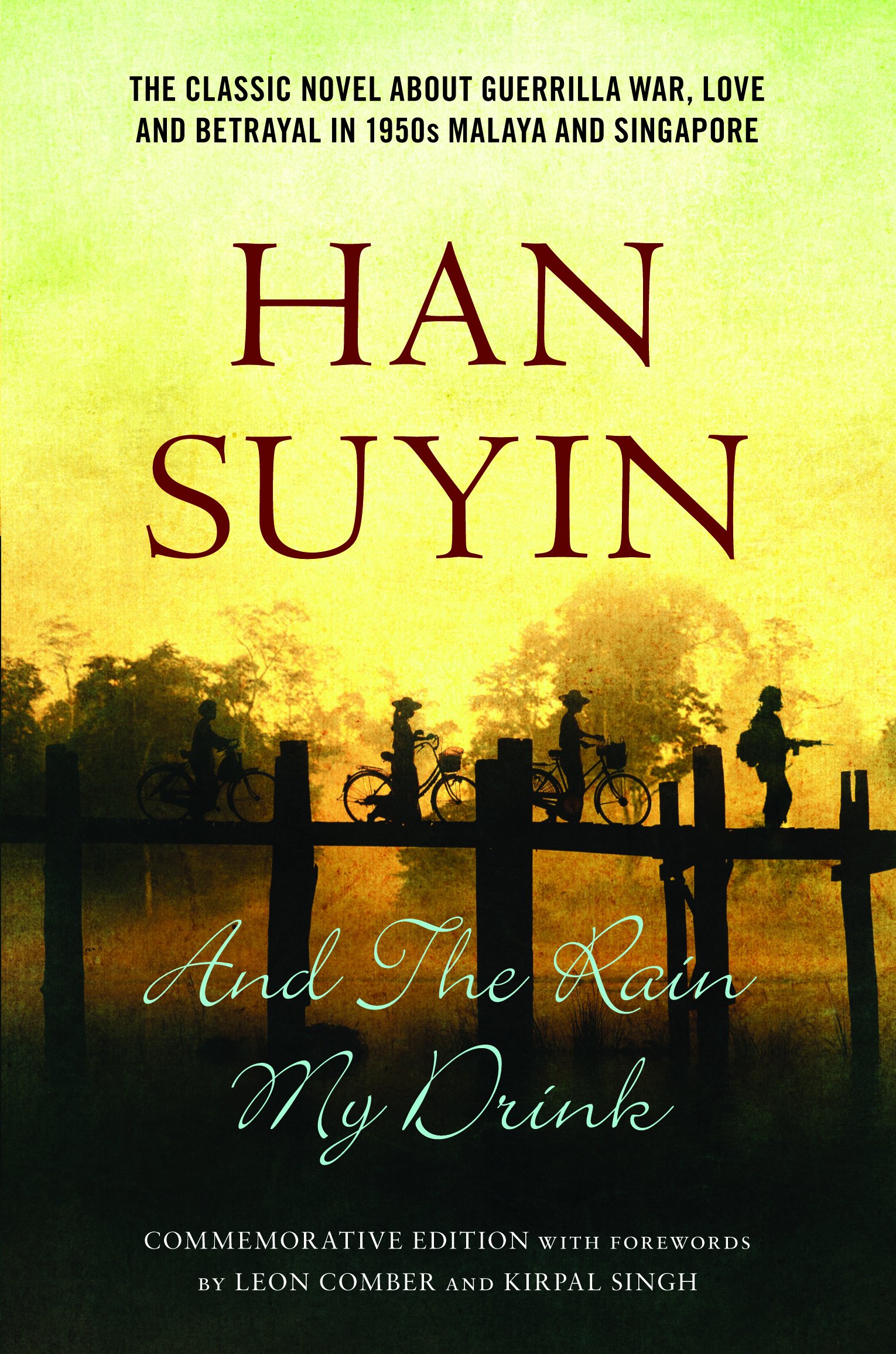
Han Suyin (her real name Chou Elizabeth Kuanghu), a Eurasian physician-turned-writer based in Malaya from 1952-1964, redefined Malayan literature through her mentorship of the trilingual journal Nanyang Literature and extensive English-Chinese translation projects that made Asian-language literary works accessible across linguistic divides.12 Throughout the 1950s and early 1960s, Han Suyin’s ideas circulated widely across Malaya’s multilingual public sphere through diverse channels: essays in international journals like Eastern World that reached local intellectuals, public lectures reported in The Straits Times and Singapore Free Press, contributions to student-run publications like the trilingual Nanyang Literature, and her novels And the Rain My Drink (1956) and The Mountain Is Young (1958), which were translated into Chinese for broader accessibility. Her defense of Chinese education, critique of Emergency-era persecution of Chinese writers, and warnings against neocolonialism — delivered despite Special Branch surveillance at her talks — positioned her as a leading voice for multilingual cultural nationalism and social realism.13 In And the Rain My Drink, Han gave voice to “one of the most marginalized groups” of the Emergency era: lower-class, rural Malayan Chinese women who navigated “between fire and water […] between two terrors, the Police, and the People Inside”.14 Rather than portray them as passive victims, Han revealed how these women, though “mistreated, mistranslated, and misunderstood”, possessed “subversive or revolutionary potential” that threatened colonial authority.15
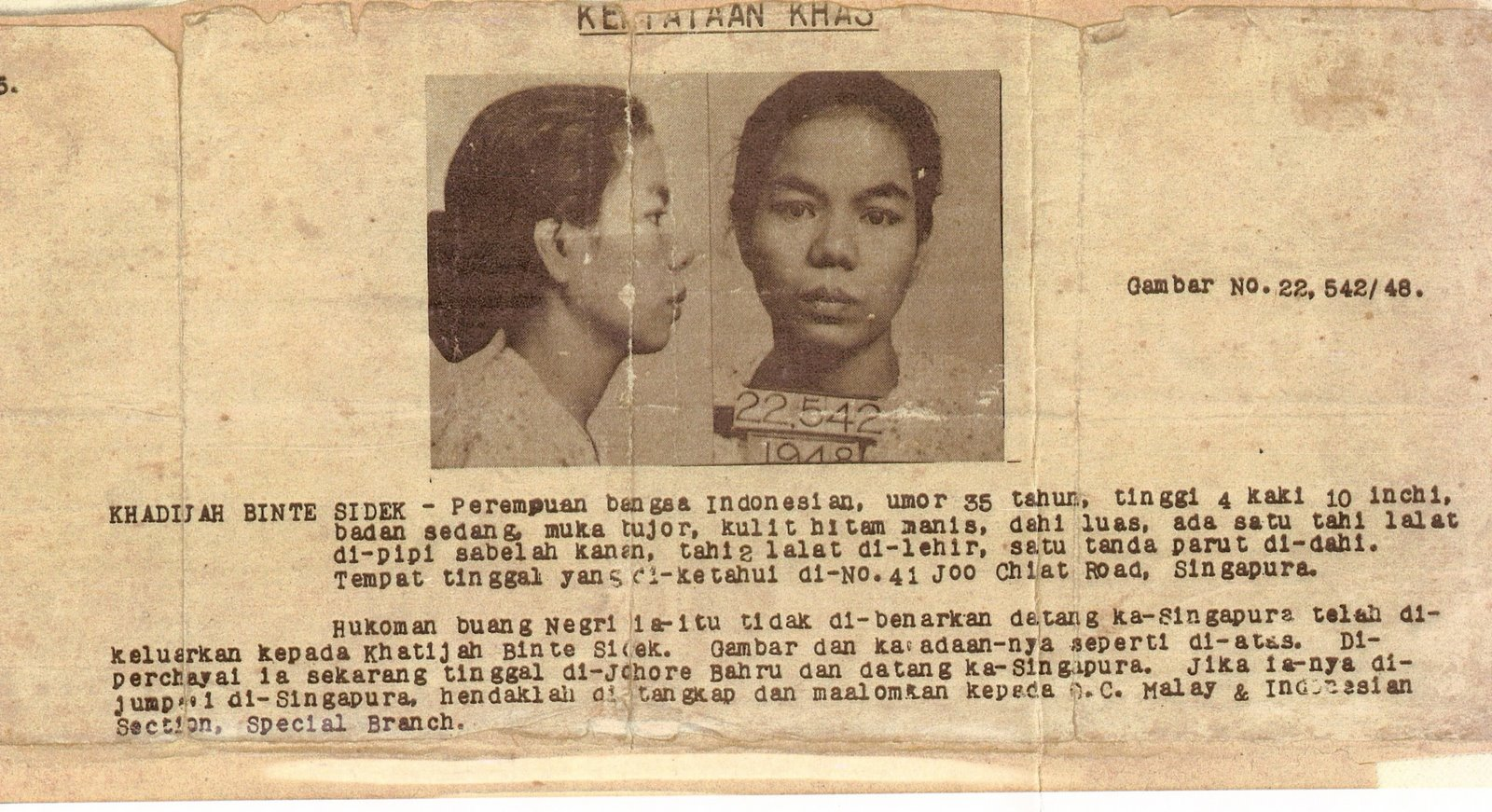
The task of recovering feminist histories across archipelagic Southeast Asia may also unearth connections which traversed the borders of nation-states. What were the possibilities for the cross-border circulation of radical feminist and anti-imperial ideas and tactics of organising? In 1946, a conversation was reported between Khatijah Sidek, a Sumatran-born activist of Minangkabau lineage, and Shen Zijiu of New Women’s Monthly.16 Sidek, a vocal feminist and leader of the paramilitary group Puteri Kesatria (Women Warriors) during Indonesia’s independence movement, visited NWM’s office in Malaya to exchange information about each country’s women’s movements. The record of their conversation touches upon the fraught intersection of racial identity with feminist ideology, amid a post-war period of heightened inter-ethnic tension and racialised political rhetoric. Khatijah, responding to Shen’s questioning re the mass killings of the Chinese minority in Java, raised instances both of Chinese women collaborating with the independence movement, and co-conspiring with the Dutch, pointing also to the unchecked retaliation of local Indonesians against overseas Chinese sympathisers. The meeting was reported to have ended in agreement–Shen and Sidek mutually acknowledging this longstanding sense of interethnic suspicion as a deterrent to the women’s movements.17
Sidek relocated to Singapore, marrying Dr Hamzah bin Mohd Taib, a Malay doctor from Johor, in 1948. In Malaya she assisted with the women’s wing of the Lembaga Kesatuan Melayu Johor, and joined the Indonesian and Malay Women’s Assembly (HIMWIM) which advocated for women’s rights. Her trajectory — from anti-colonial activist to detainee, exile, and party organiser across UMNO and PAS — illustrates how women’s political commitments were shaped by, and often worked against, the racially exclusionary logics of nationalist movements. Her insistence on “Merdeka!” over “Hidup Melayu!” as a rallying cry signals a feminist universalism that cut across ethnic and partisan lines. Detained under the British Emergency Act, exiled to Johor, and eventually expelled from UMNO for her radicalism, Sidek’s career traces a pattern common to many women in this archive: marginalised within the very movements they had struggled to build.18 Her connections extended across racial and national boundaries too. The publication of her collected writings as a memoir in 1995 came at the request of Han Suyin — who had herself resided in Johor during Sidek’s period of exile, practicing medicine there in the 1950s.
Literature, art and activism were deeply intertwined. The Equator Art Society (EAS), known in Chinese as 赤道艺术研究, emerged from this crucible of anti-colonial sentiment and leftist idealism, becoming one of the most significant — and ultimately controversial — art collectives in Singapore’s history. Founded on June 22, 1956 by artists including Lim Yew Kuan, Lee Boon Wang, Tay Kok Wee, Chua Mia Tee, Lai Kui Fang, and Tay Boon Pin — many of whom had been members of the recently dissolved Singapore Chinese High Schools’ Graduates of 1953 Art Association — the EAS carried forward the torch of socially committed art that depicted the struggles of ordinary people, choosing Auguste Rodin’s The Thinker as their emblem to symbolize the artist as a contemplative figure engaged with society’s struggles rather than retreating into pure aesthetics.19
The society’s mission was ambitious: to pursue “truth, perfection and beauty” through art that faithfully reflected the reality of life; as co-founder, Lee Boon Wang wrote in the foreword to their first exhibition, they sought to build up the Malayan art scene through their collective efforts.20 With a monthly membership fee of just one dollar, it attracted not only artists but also hawkers, students from both Chinese and English schools, and graduates who became teachers; members like Mdm Tay Poh Ching, who could not afford institution fees elsewhere, found a home at the EAS where they could learn art.21 The society branched into four wings: visual arts, literature, theatre, and music. Members worked together in the same house, holding frequent seminars and sessions to exchange ideas.
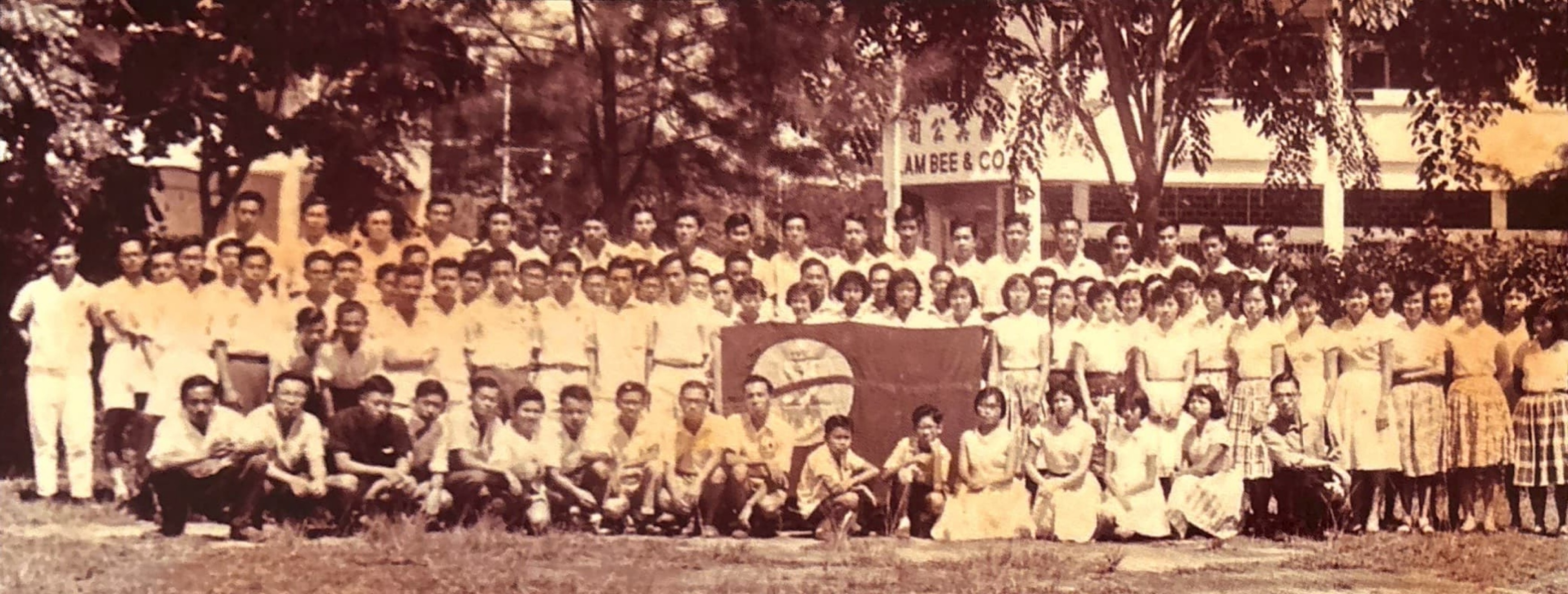
As shown in photographic records, many women participated in EAS, though their presence in the historical record remains fragmentary.22 Beyond Mdm Tay Poh Ching, artists like Han Peifang [韓佩芳], Xiao Yin [蕭茵], and possibly Mei Peilin [美沛霖] contributed works to the society’s exhibitions, particularly the Fifth Art Exhibition in 1960. Their names also appear in connection with the 1953 Art Association’s activities, suggesting they were part of the leftist student art movement from its earliest days — not merely students seeking affordable instruction, but committed artists engaged in the same politically charged cultural work as their male counterparts. Little is known about these women artists — what motivated their participation or how they navigated the male-dominated world of social realist art?
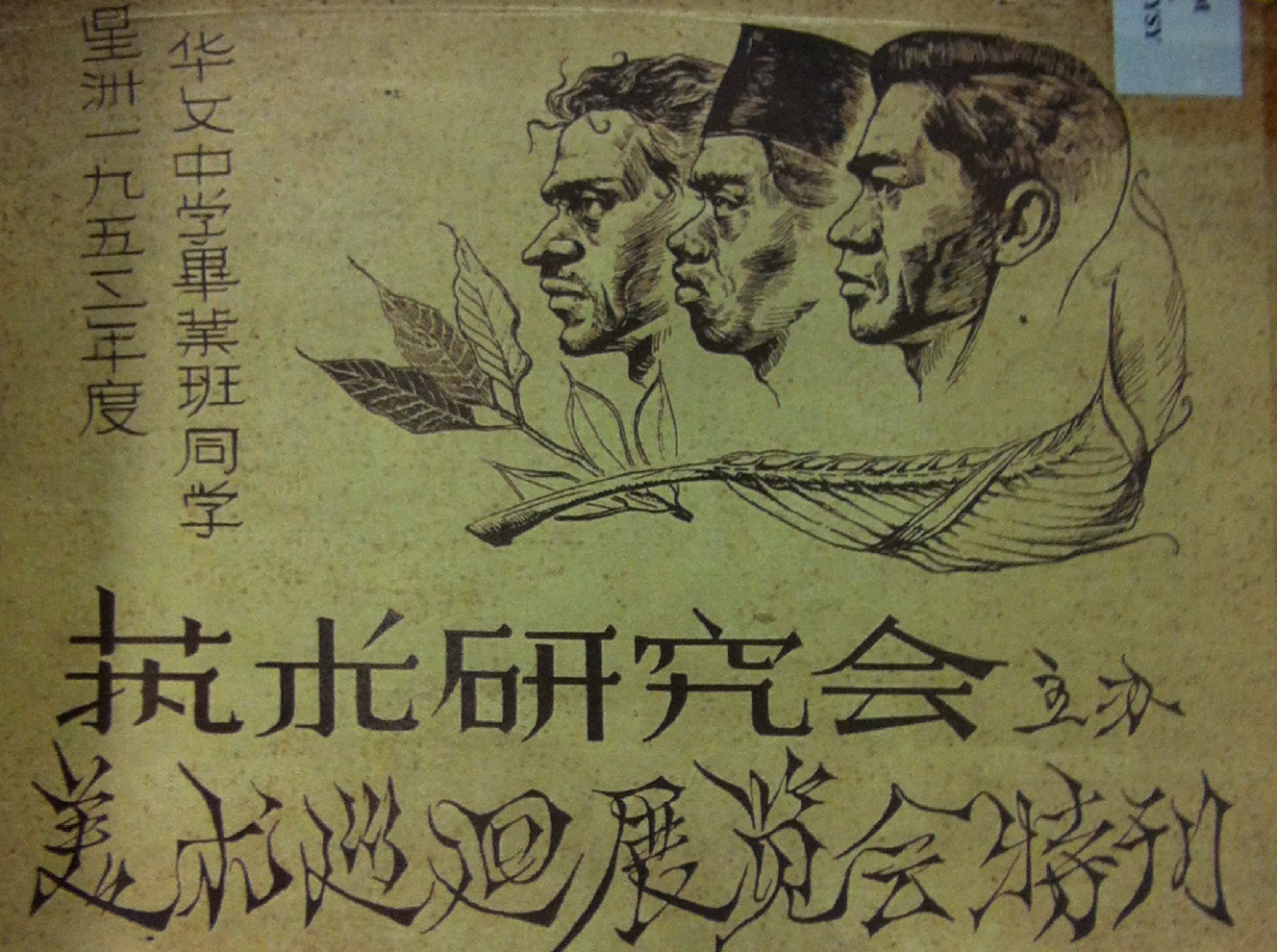
The EAS distinguished itself through an unexpected alliance with the newly elected PAP government. When the People’s Action Party came to power in 1959, it initially embraced leftist causes, and the EAS’s social realist paintings resonated perfectly with government interests.23 Works like Lai Kui Fang’s Bedok Flood (1959) and Chua Mia Tee’s National Language Class (1959) captured the spirit of Malayan nationalism the government wished to promote. Minister for Culture S. Rajaratnam opened the EAS’s second exhibition in February 1960, explicitly acknowledging their endeavor to create a Malayan art style.24 By the mid-1960s, however, following Singapore’s separation from Malaysia in 1965, there was growing intolerance for leftist activism (Operation Cold Store in 1963 had already seen 150 political activists detained), EAS was disbanded on the grounds that the society had “wilfully contravened” the regulations outlined in the Societies Act.25
It is important to recognize that organisations such as EAS did not emerge from a vacuum; yet art historical accounts have largely treated visual arts organizations like EAS as disconnected from the literary, journalistic, and feminist organizing that preceded and surrounded them. What if we ask instead: How did the socialist feminist frameworks circulated through publications like New Women’s Monthly shape the political consciousness of EAS participants and audiences? How might the presence of women artists within EAS — Han Peifang, Xiao Yin, Mei Peilin, Chan Yuen Song, Mdm Tay Poh Ching — reflect the ideological groundwork laid by figures like Shen Zijiu and Han Suyin? This reframing is crucial: it positions women not as marginal contributors to an essentially masculine project of social realist art, but as central to the feminist socialist consciousness who brought with them theoretical frameworks developed through decades of literary activism and organizing. Recovering these linkages is not merely a matter of filling historical gaps; it challenges the disciplinary boundaries that have obscured how feminist thought and socialist organizing were integral to — not peripheral to — the development of visual culture in postcolonial Southeast Asia.26
Indonesia: The Women behind Api Kartini and Sedar
Api Kartini was a magazine published from 1959 to 1964 by Gerakan Wanita Indonesia (GERWANI, Indonesian Women’s Movement). Following the anti-communist purge after October 1 1965, GERWANI was banned, and the New Order regime made the organization central to its legitimizing narratives throughout its 32-year rule. Api Kartini publications were removed from Indonesian libraries, with surviving copies scattered across archives outside of Indonesia, creating a geography of displacement that paralleled the fates of its contributors: imprisoned, disappeared, or forced into silence.
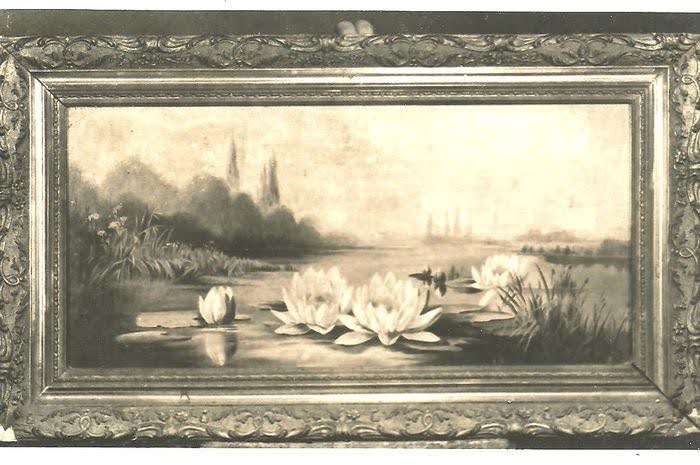
The early works of Kartini (1879-1904), a feminist and nationalist icon, who also inspired Api Kartini27 to be named as Gerwani’s magazine: “From Kartini, we will take her fire, not her ashes… We chose the name Api Kartini [Kartini’s Flame] for this magazine, which we cannot separate from the ideals and thoughts of the pioneer of the Indonesian women’s movement. That is, the ideal of elevating the status of women.”28 Kartini herself, as an image of an Indonesian woman’s icon and national hero, has experienced different political periods of Indonesia. In the beginning, her image started to be seen as one of the first women who wrote in the colonial language (Dutch) to critique the condition of women in colonial times. In the early revolutionary times in the new Republic, Kartini is seen as an anti-colonial figure and pushing the ideas of emancipation. This portrayal stood in stark contrast to Kartini’s depoliticisation under the New Order regime, which reduced her to a ceremonial Javanese princess — commemorated superficially each year on Kartini Day through the wearing of traditional kebaya attire and the sanggul hairdo, while her writings remained unread and undiscussed, her ideas rendered uninspiring, and her work distorted through diluted translations.29 Kartini’s legacy has become the subject of renewed polemic in contemporary scholarship,30 reinvigorated by the recent publication of her complete works and the wider availability of her writings in translation. Meanwhile, the surfacing of images of her lost paintings31 — along with those of her sisters, all of which disappeared in the turbulence of 196532 — has begun to raise urgent questions about who the early Indonesian modern women painters truly were.
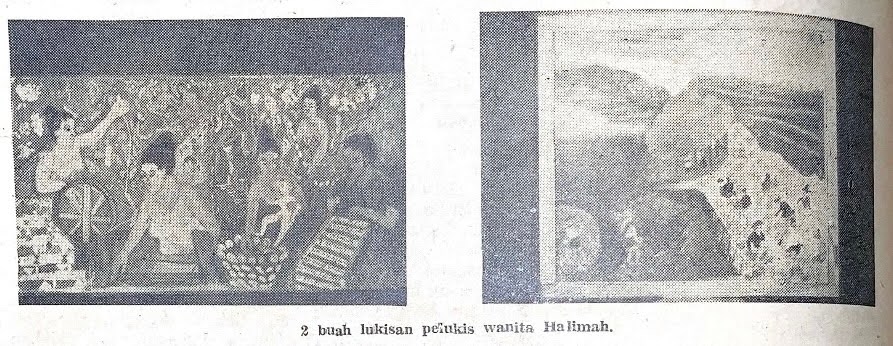
As GERWANI’s political commitment was closely aligned with LEKRA (Lembaga Kebudayaan Rakyat, or League of People’s Culture), the leftist cultural organization also affiliated with the PKI, there was likely significant overlap between the women producing Api Kartini and the cultural workers of LEKRA. Both organizations were targeted in the same wave of suppression, with their members subjected to imprisonment and erasure. The scattered archive itself became a form of exile: for decades, these publications remained nearly inaccessible within Indonesia, surviving copies confined to the restricted sections of the national library — present, yet unreachable to the general public.33 Within their pages were stories of and by women artists, writers, and activists, among them Siti Halimah, an artist who disappeared in the 1965 purge. Her exile was absolute in the most literal sense: she left behind only traces in a magazine that had itself been exiled.
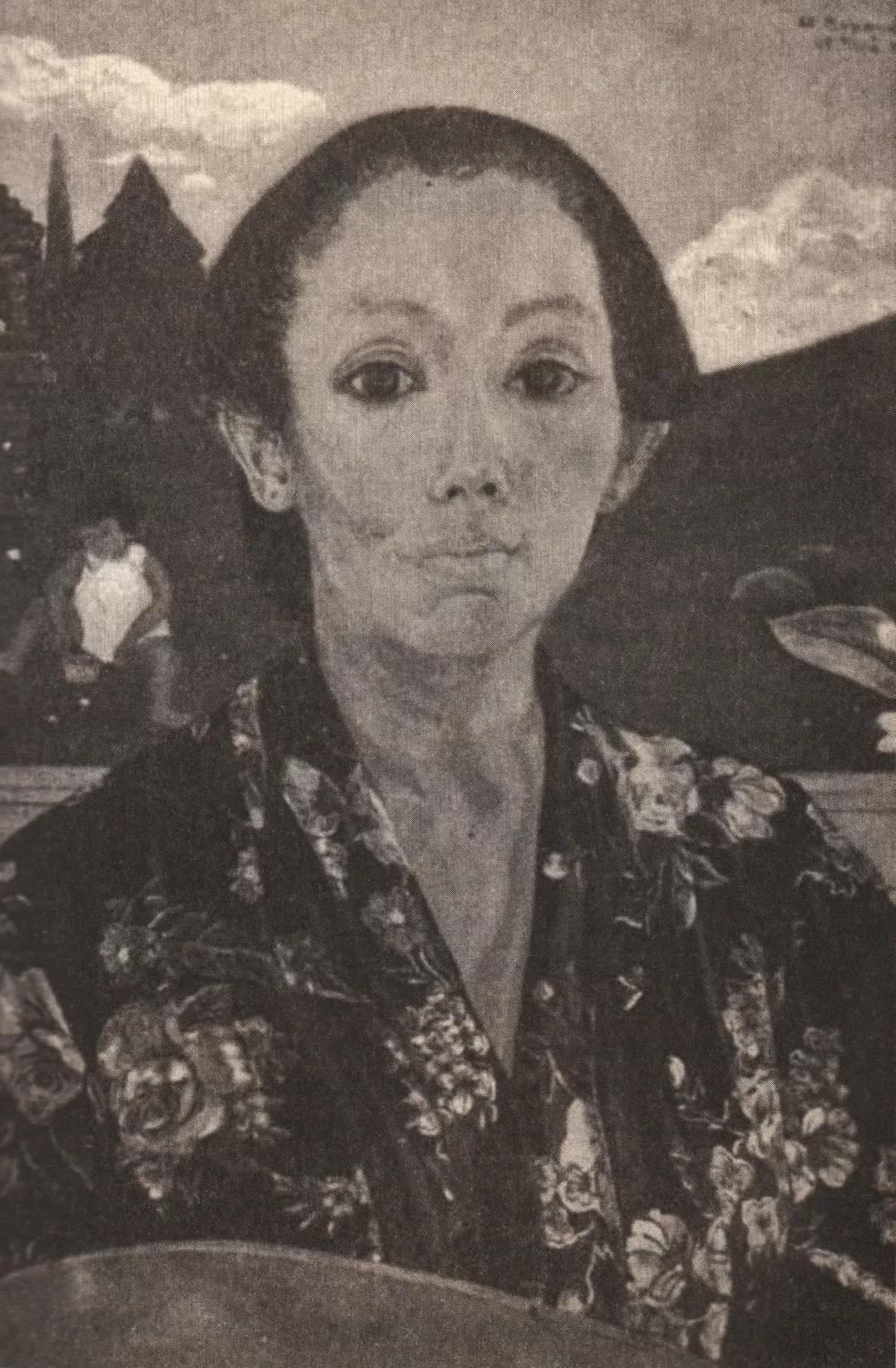
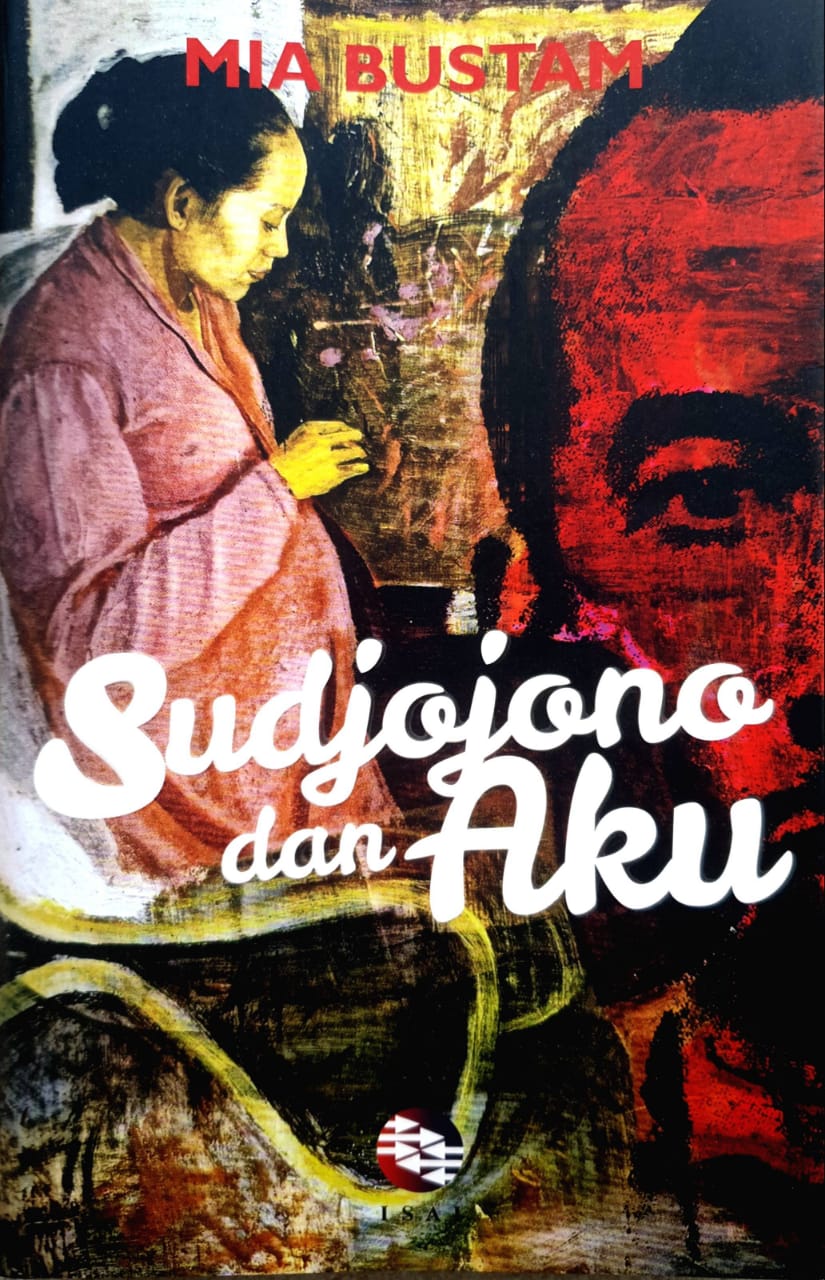
In a piece by editor Sugiarti Siswadi, she wrote about artist Mia Bustam’s (then head of LEKRA Yogyakarta)34 desire to hold a solo exhibition, an aspiration that was never realized when she was alive, and only happened recently.35 Both women were later imprisoned by the New Order regime without trial. Mia Bustam (1920-2011) is an Indonesian painter, embroiderer, writer, and translator. She became a single mother of eight children in 1959, after her marriage to S. Sudjojono, an Indonesian communist painter, was terminated on his request to have a polygamous marriage, and Mia refused, demanding the divorce finalized. The marriage ended in a public scandal after Sudjojono’s public affair, which later caused his expulsion from the Indonesian Communist Party. After the separation, Mia Bustam’s artistic life expanded. She joined Seniman Indonesia Muda (SIM, Indonesian Young Artists) and became a member of Lembaga Kebudayaan Rakyat (LEKRA, Institute for the People’s Culture). In 1963, she became the head of LEKRA Yogyakarta. Her oil painting Potret Diri (Self-Portrait, 1959) was exhibited in the Eastern Bloc countries by LEKRA (1964 - 1965), and at the 45th Year of Indonesian Communist Party Exhibition on 23 May 1965 in Jakarta. This painting later went missing post the riots in October 1965, followed by the purge and mass killings of the Indonesian left. The only remnant of it is a black and white photo provided by Marah Djibal.
Mia Bustam’s artistic career, spanning barely seven years, was abruptly cut short when she was arrested by the army at her home on 23 November 196536 — taken in front of her seven children, a month after her eldest son, Tedjabayu, had already been seized. She was subsequently imprisoned by the New Order for thirteen and a half years without trial, moved between women’s prison camps across Java. Yet she did not stop making art: she painted for prison guards, produced embroideries, illustrations, and handicrafts as a means of survival, and even designed a garden for her fellow political prisoners.
Released from prison after 1978, Mia decided to write her memoir, which was later published after the downfall of Soeharto and the New Order regime. The memoirs of Mia Bustam became an important record of the art and social political scene during the Japanese occupations, the early days of the newly independent Republic, and all through the revolution, including the lost era of the Indonesian leftist artist life before 1965. This vibrant, very personal record of her memoir became the rich source from the point of view of a forgotten woman artist, marginalized throughout Indonesian art history.
Her first memoir, Sudjojono dan Aku (Sudjojono and Me, 2006), and her prison memoir, Dari Kamp ke Kamp (From Camp to Camp, 2008), appeared nearly two decades ago — yet their impact on the mainstream narrative of Indonesian art history was minimal, doing little to unsettle the enduring glorification of her ex-husband, S. Sudjojono, as the ‘Father of Indonesian Modern Painting’. Hard to find and long out of print, the books circulated at the margins. It was the posthumous publication of two further memoirs by her family — Kelindan Asa dan Kenyataan (The Entanglement of Hope and Reality, 2022) and Mutiara Kisah Masa Lalu (Pearls of Past Stories, 2024) — that has begun to draw new readers, and new scholarly attention, to Bustam’s long-overlooked story.
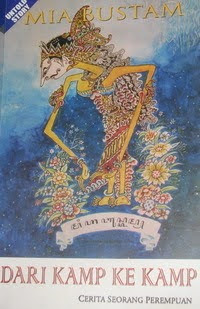
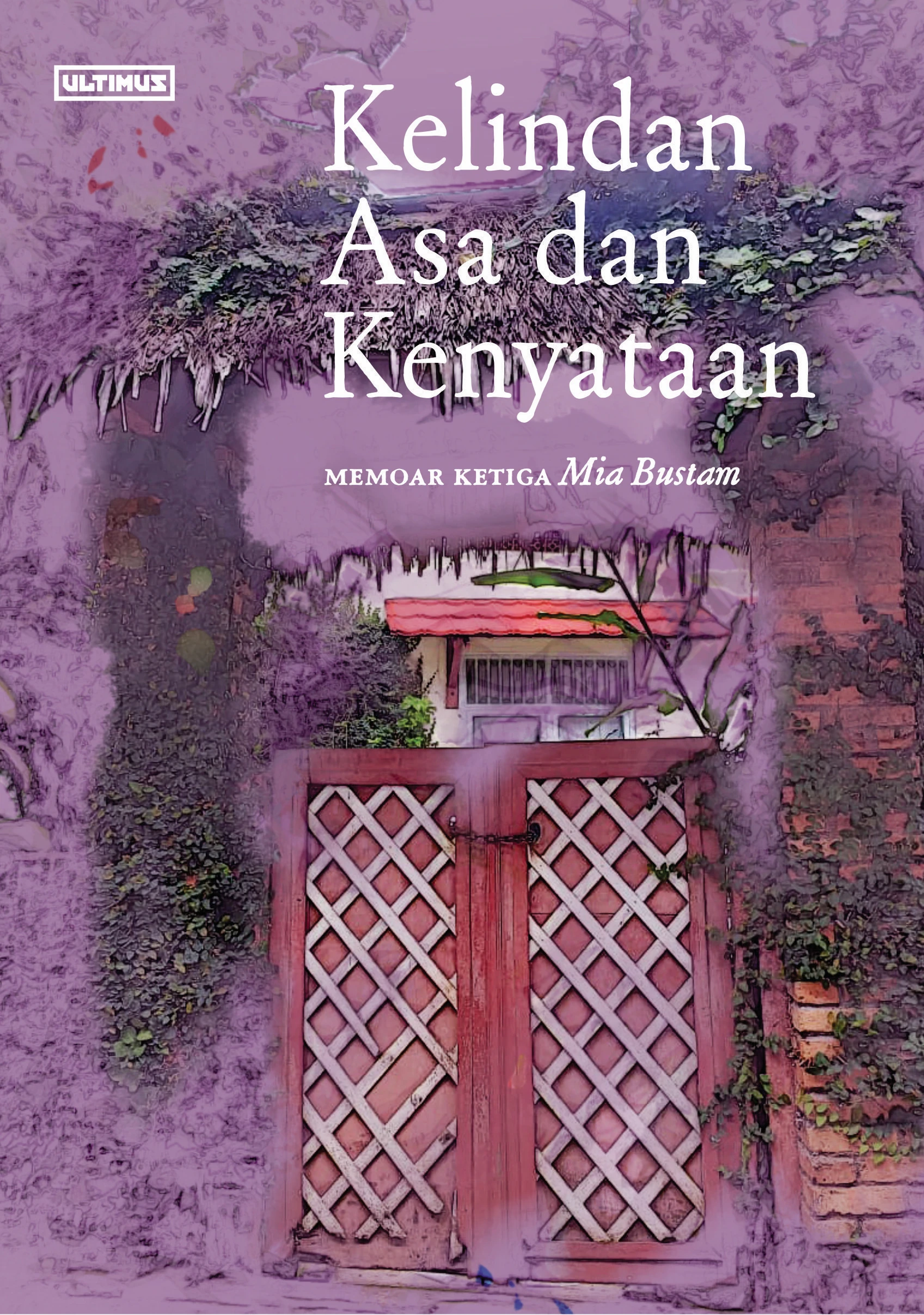
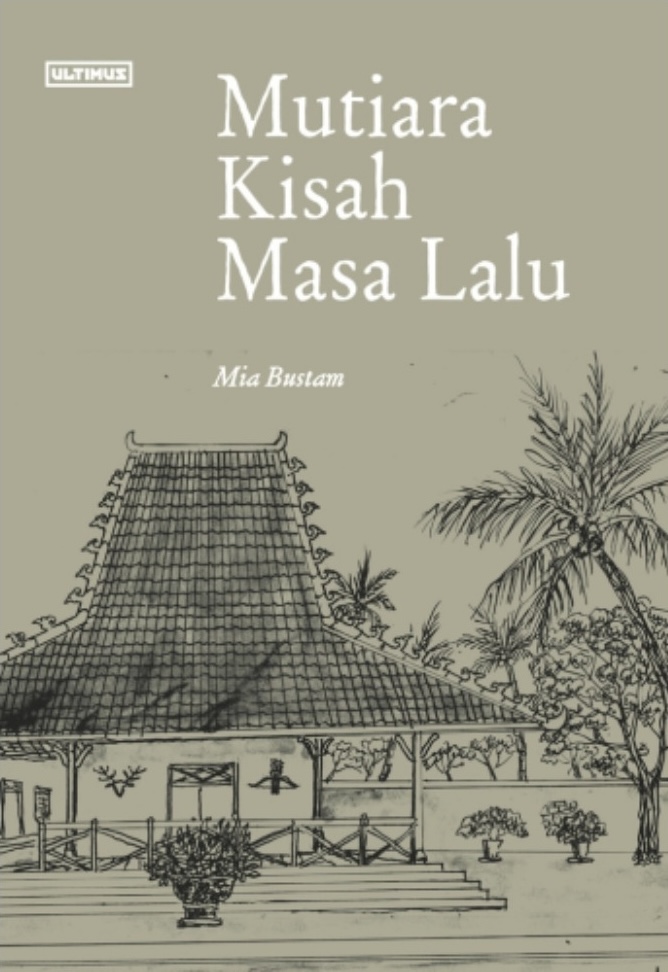
Like Mia Bustam, Siti Rukiah (1927–1996) represents a crucial case of literary and political exile within LEKRA’s networks. Born in Purwakarta, West Java, Rukiah was among the productive writers of the 1945 Generation who published significant literary works in postcolonial Indonesia. Her novel Kedjatuhan dan Hati (The Fall and the Heart) appeared in 1950, followed by the poetry and short story collection Tandus (Desert) in 1952. In 1953, the Badan Musjawarah Kebudajaan Nasional (National Cultural Board) awarded her a literary prize for Tandus. Her fiction explored the tensions Indonesian women faced during the revolutionary period — caught between new political ideals and persistent traditional structures. As literary scholar Yerry Wirawan observes, Rukiah’s stories reveal ‘the unequal gender-based political expression of revolutionary ideals,’ 37 demonstrating that even after independence, ‘women still have to depend on their partner, financially and emotionally, and to disregard their own ideals’. Elected to LEKRA’s National Council at the organization’s first congress in January 1959, Rukiah advocated that ‘progressive artists should visit peasants’ villages and labor camps’.38 After the 1965 purge, she was detained and imprisoned without due process, spending several years in detention before her release in the late 1960s. She lived the remainder of her life in difficult circumstances, raising six children.39 Although her name appears in contemporary Indonesian literary textbooks, her works became largely inaccessible: in November 1965, Tandus’ distribution was halted by Balai Pustaka, and her writings were not republished until 2017, when the independent press Ultimus brought out new editions.
The Api Kartini editorial team included Editor-in-Chief Maasje Siwi, with editors S. Asijah, Darmini, and Parjani Pradono, and contributors S.K. Trimurti, Rukiah Kertapati, Sugiarti Siswadi, Mr. Trees Sunito, Sulami, Rukmi B. Resobowo, Sartini, Sulistyowarni, Sutarni, Siti Suratih, and Sudjinah — names that would soon become taboo, closely identified with GERWANI in Soeharto’s Indonesia. That these women have been recovered at all is in part due to the archival work of Mirat Collective, a young feminist theatre group from Solo, whose research traced the faces behind these names and brought them before a new generation. 40
A further missing piece of this archive has recently come to light: a 1951 edition of Wanita Sedar,41 published before GERWIS (Gerakan Wanita Indonesia Sedar) became GERWANI. Reading through what is currently the only known surviving edition, one can already discern the embryonic form of what would later become Api Kartini — the publication GERWANI would go on to produce after the organisation’s transformation in 1954. Between this solitary edition of Wanita Sedar and the launch of Api Kartini in 1959, there remains a significant gap in the known publication record, a silence that itself speaks to the precariousness of this archive.
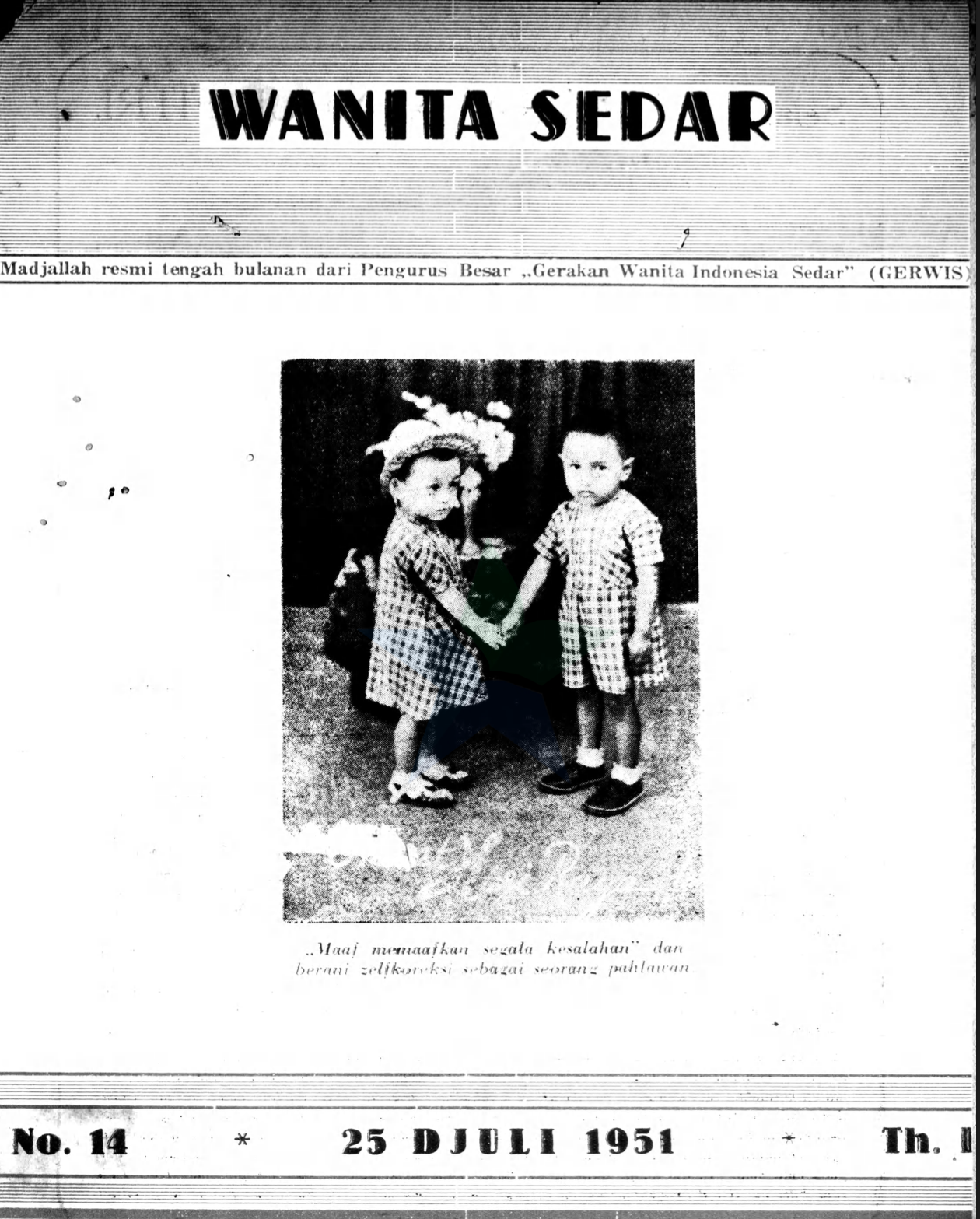
What is particularly striking about this sole surviving edition of Wanita Sedar is the decidedly transnational orientation of its contents. The issue documents the sending of three GERWIS members to Berlin — Darmini, representing the Workers’ Party and SOBSI; Nuraini from GERWIS Aceh; and Sabarjati, a poet from Jakarta who wrote for Revolusioner magazine — alongside articles on women in Czechoslovakia and an account of the struggle of the Vietnamese people by Pham Guang Boi. Read as the embryonic form of what GERWIS would become after its transformation into GERWANI, this single edition offers a rare glimpse into the transnational solidarities and accumulated ideas that would be passed on to the next generation of Indonesian women activists.
Sedar published from 1930 to 1932, represented an earlier chapter in Indonesian women’s activism and a predecessor to Api Kartini’s radical tradition. Founded by the organisation Isteri Sedar [Conscious Wives] in Bandung (first established by Soewarni Pringgodigdo,) it was Indonesia’s first radically nationalist women’s publication, taking anti-polygamy, anti-colonial, and anti-discrimination stances while documenting women’s struggles worldwide. Though Sedar ceased publication under colonial pressure in 1932, its editorial vision of feminist internationalism would resurface decades later in Wanita Sedar and Api Kartini, suggesting how radical ideas persist even when their material forms are suppressed. The editorial board consisted of Nn. Moedinem (Chair), Nj. Soewardjo (Vice Chair), Nj. Njono (Secretary), Nj. Baskara (Treasurer), and Nj. Kanthaatmaca (Commissioner).
Soewarni Pringgodigdo, who led Isteri Sedar and was frequently quoted in Sedar, became a prominent political figure, serving on the Supreme Advisory Council (1945-1949) and in the Indonesian Parliament (1950-1955). Recognized as an early Javanese feminist, she championed anti-polygamy positions from the first Indonesian Women’s Congress in 1932, notably opposing Muslim women’s organizations like Aisyiyah that supported polygamy. Unlike many of her Api Kartini successors, Pringgodigdo’s transition into formal politics perhaps protected her from the formal political exile that befell later generations of radical feminists (though the early suppression of Sedar itself foreshadowed the more violent silencing to come).
Vietnam: Exiled Voices
In Vietnam, when cultural figures of the early twentieth century, particularly writers and journalists, are invoked, public attention has tended to focus almost exclusively on male authors, such as Tản Đà (1889 – 1939). This emphasis has obscured the presence and contributions of numerous women writers, journalists, public speakers, and activists, including Đạm Phương (1881 – 1947), Huỳnh Thị Bảo Hòa (1896 – 1982), Nguyễn Thị Manh Manh (1914 – 2005), and, most notably, Sương Nguyệt Anh (1864 – 1921). The latter is recognized as one of the first female journalists in Vietnam and served as editor-in-chief of one of the earliest newspapers dedicated to women.
Sương Nguyệt Anh was born Nguyễn Ngọc Khuê in Bình Đông village, Ba Tri district, Bến Tre province. She was the fifth daughter of the renowned blind patriotic poet Nguyễn Đình Chiểu (1822 – 1888), and was therefore also known as Năm Hạnh. In her literary career she adopted several pen names, including Xuân Khuê, Nguyệt Nga, and Nguyệt Anh. The name “Sương Nguyệt Anh,” meaning “Widow Nguyệt Anh,” was assumed after the death of her husband, when their daughter was only two years old. In keeping with her family’s patriotic spirit, she reportedly sold part of her landholdings to support the Đông Du (Go East) movement led by Phan Bội Châu.
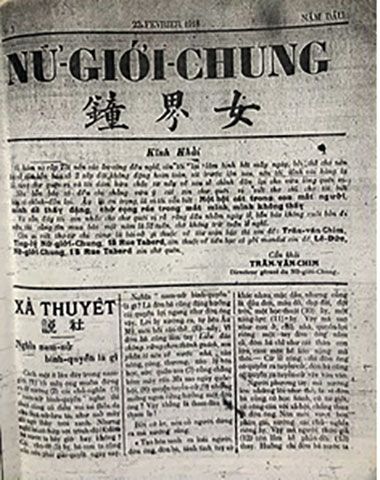
In 1917, Sương Nguyệt Anh was invited to serve as editor-in-chief of the newspaper Nữ Giới Chung (literally, “The Women’s Bell,” with “chung” meaning “bell”).42 The first issue appeared in Saigon on February 1, 1918. As a public and legally sanctioned newspaper established under the reformist policy of Albert Sarraut, then Governor-General of Indochina, the paper officially declared its aim to promote women’s education, to serve as a “bell” awakening women to participation in social affairs, to avoid political discussion, and not to compete with men. The opening statement, “Mấy lời kính tỏ” (“A Few Respectful Words”), published in the first issue (pp. 1–3), outlined four principal objectives:
- To cultivate moral foundations.
- To refine common knowledge and understanding.
- To promote commerce and industry.
- To foster bonds of affection and solidarity.
Nữ Giới Chung introduced eight principal sections.43 Sương Nguyệt Anh provided detailed explanations of each category. The Editorial section addressed matters of general benefit to women, discussing issues of fairness and moral sentiment, promoting ethical conduct and encouraging commercial and industrial activity. Vocational Studies presented practical skills – whether manual or mechanical – that could be self-taught and usefully practiced at home. Domestic Management covered everyday household matters such as sewing, cooking, accounting, medicine, childrearing, and domestic discipline. The Literary Garden featured poetry and prose by accomplished writers, intended to cultivate sentiment and refine character. The Miscellany included aphorisms, humorous anecdotes, riddles, and recreational activities beneficial to intellectual development. Current Affairs reported on contemporary events at home and abroad relevant to women, whether contributed by correspondents or translated from the French press, adhering to factual reporting. Biographies commemorated exemplary women – virtuous mothers, devoted daughters-in-law, and talented figures – particularly Vietnamese women whose historical contributions risked being forgotten.44 Finally, the Fiction section presented narratives by major novelists, using characterization and plot to convey moral lessons and social critique.
Although the newspaper formally claimed to avoid political matters and to focus instead on social and cultural issues, in practice Sương Nguyệt Anh selected numerous pieces imbued with patriotic sentiment and resistance to colonial rule. These included poems such as “Thơ Vịnh Bà Triệu Ẩu” and “Thơ Vịnh Bà Trưng Nhị,” as well as the editorial “Lòng yêu nước của đờn bà Pháp” (“The Patriotism of French Women”). Such writings expressed anti-colonial sentiment and called upon women to engage in issues concerning the nation’s destiny. Viewing the newspaper and its influence as a threat, the colonial authorities shut down Nữ Giới Chung on July 19, 1918, after only five months and nineteen days of publication and twenty-two issues.
After the closure of the newspaper, Sương Nguyệt Anh returned to her hometown, where she followed her father’s vocation by practicing traditional medicine, composing poetry and prose, and teaching. She passed away four years later. The existence of Nữ Giới Chung, though brief – much like Sương Nguyệt Anh’s own life – nonetheless constituted a significant continuation of the longstanding tradition of Vietnamese women’s public engagement. It formed part of an enduring historical lineage that stretches from the Trưng Sisters and Lady Triệu to later generations of women intellectuals, journalists, and artists, such as Nguyễn Thị Minh Khai and Lê Thị Lựu.
In a 1933 letter from revolutionary Nguyễn Thị Minh Khai to Lý Ưng Thuận, her friend and fellow organizer in the anti-colonial movement, Nguyễn Thị Minh Khai asks for the magazine, Phụ nữ Tân tiến (Progressive Women). She pleads, “If you cannot send the magazine to me in its entirety, tear it, and send me the pages which contain the poetry and texts concerning finance and feminism.”45 At the time that she wrote the letter, Nguyễn Thị Minh Khai was imprisoned in Hong Kong, writing to Lý Ưng Thuận who was also in exile in Nanjing at the time as the communist party was forced underground.
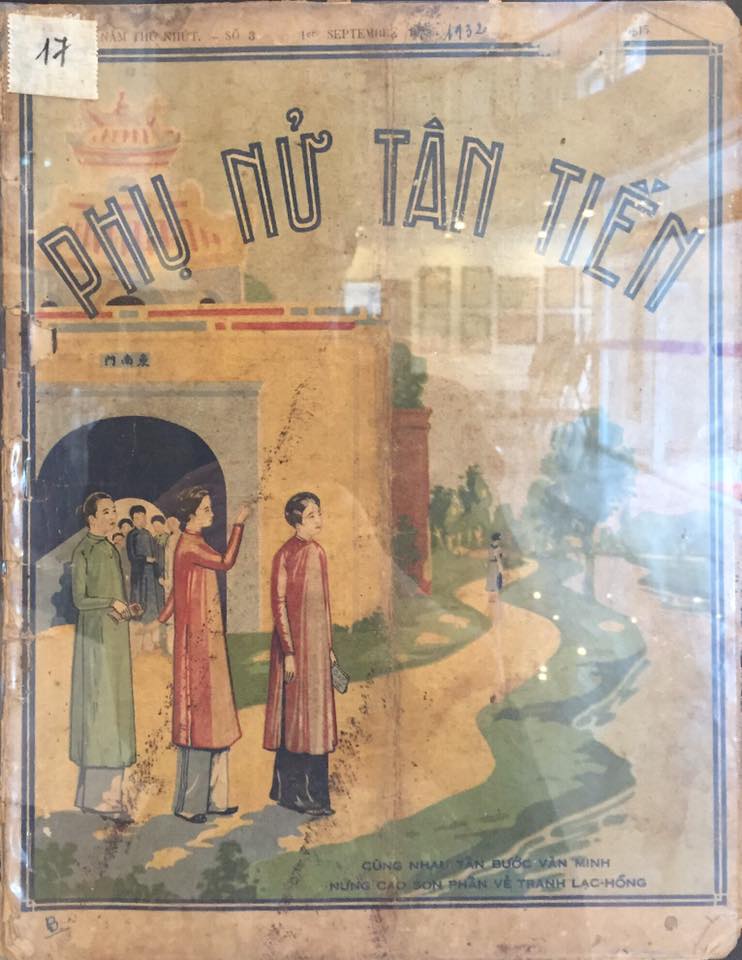
Phụ nữ Tân tiến was only one of many women’s magazines published at the time, the first one being the aforementioned Nữ Giới Chung (Women’s Bell) and the most well known Phụ nữ Tân văn (New Women’s Literature).46 Founded by Cao Thị Khanh and published in Saigon from 1929-1935, the magazine sought to foster literacy and new ideas amongst women in Vietnam. These magazines provide a crucial site where modern Vietnamese feminism took literary form and now serve as a rare archive to understand how these ideas circulated despite uneven literacy, censorship, and colonial rule.47
Phụ nữ Thời đàm (Women’s Current Affairs Discussions), published out of Hanoi from 1930-1934, is another notable magazine that used its platform to debate major social issues of the day, questioning traditional customs and highlighting gender inequality within broader societal reform.
What Nguyễn Thị Minh Khai’s letter reveals is that these magazines served as a way for women to have a conversation with one another across space and time. While content was often limited to family matters and domestic duties, politics were occasionally discussed, particularly in Phụ nữ Tân văn and Phụ nữ Thời đàm.
But how far reaching was their knowledge of women internationally and their ability to engage with leftist ideas of the time? For clues, we might look to the text Vấn đề Phụ nữ, published by Nguyễn Thị Kim Anh, who historian David Marr argues is a pseudonym for Nguyễn Thị Minh Khai48. The fifty-five page booklet contains a sweeping and impressive survey of the status of women’s rights globally and throughout history and an assessment of women’s roles in the burgeoning socialist revolution and anti-fascist struggle.
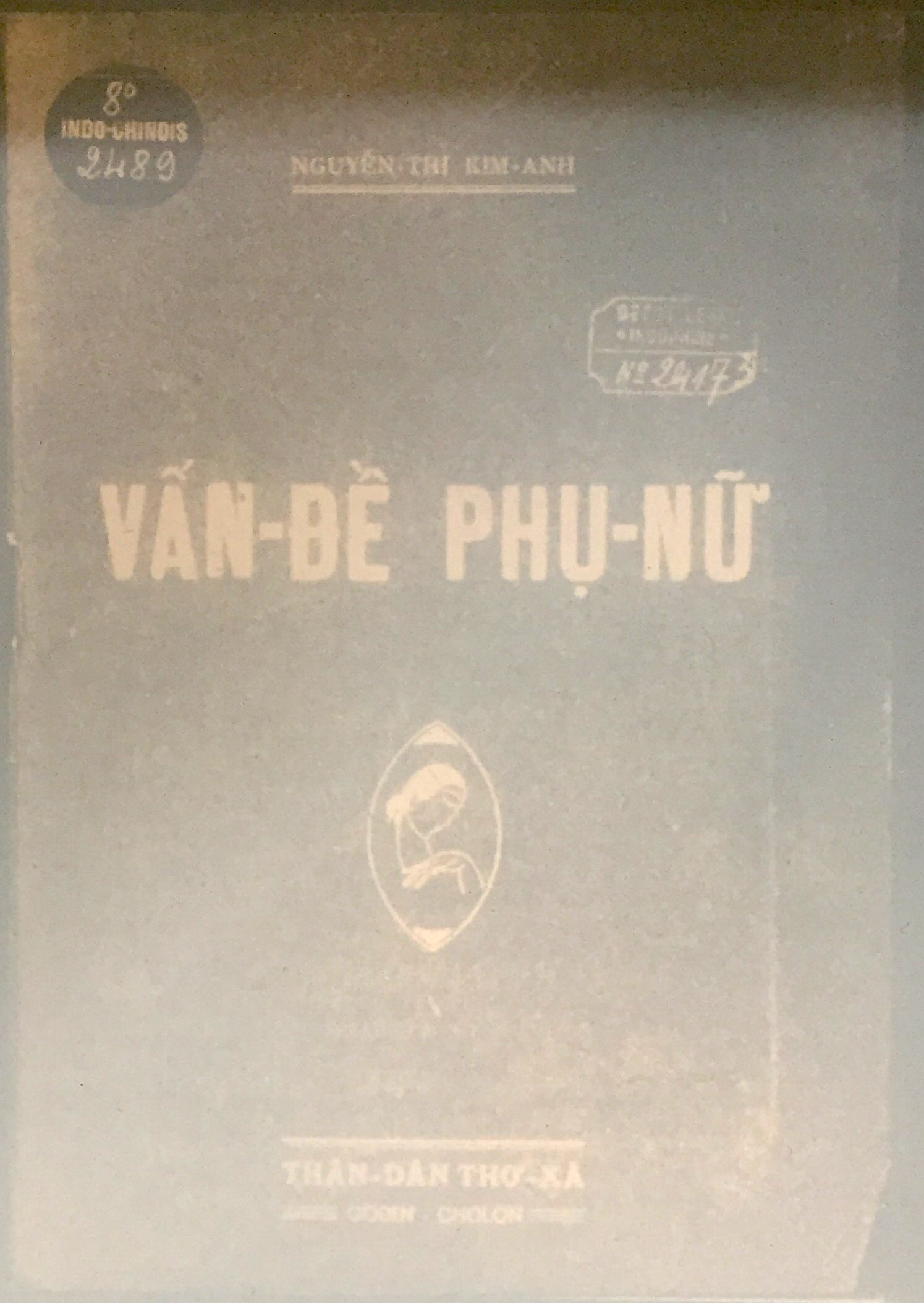
Near the end of the text, Kim Anh observes, “History shows that capitalist democratic freedom has not been for everyone. The liberation of bourgeois women is not complete liberation for women of all classes.”49 She shows an awareness of the intersectional effects of class and gender on liberation struggles, thus a deep engagement into anti-capitalist theory and a sense of its limitations in practice.
The magazines and documents anticipate conscious-raising sessions in Western feminist history where the sharing of lived experiences of being a woman was a first and important stage in solidarity struggles.
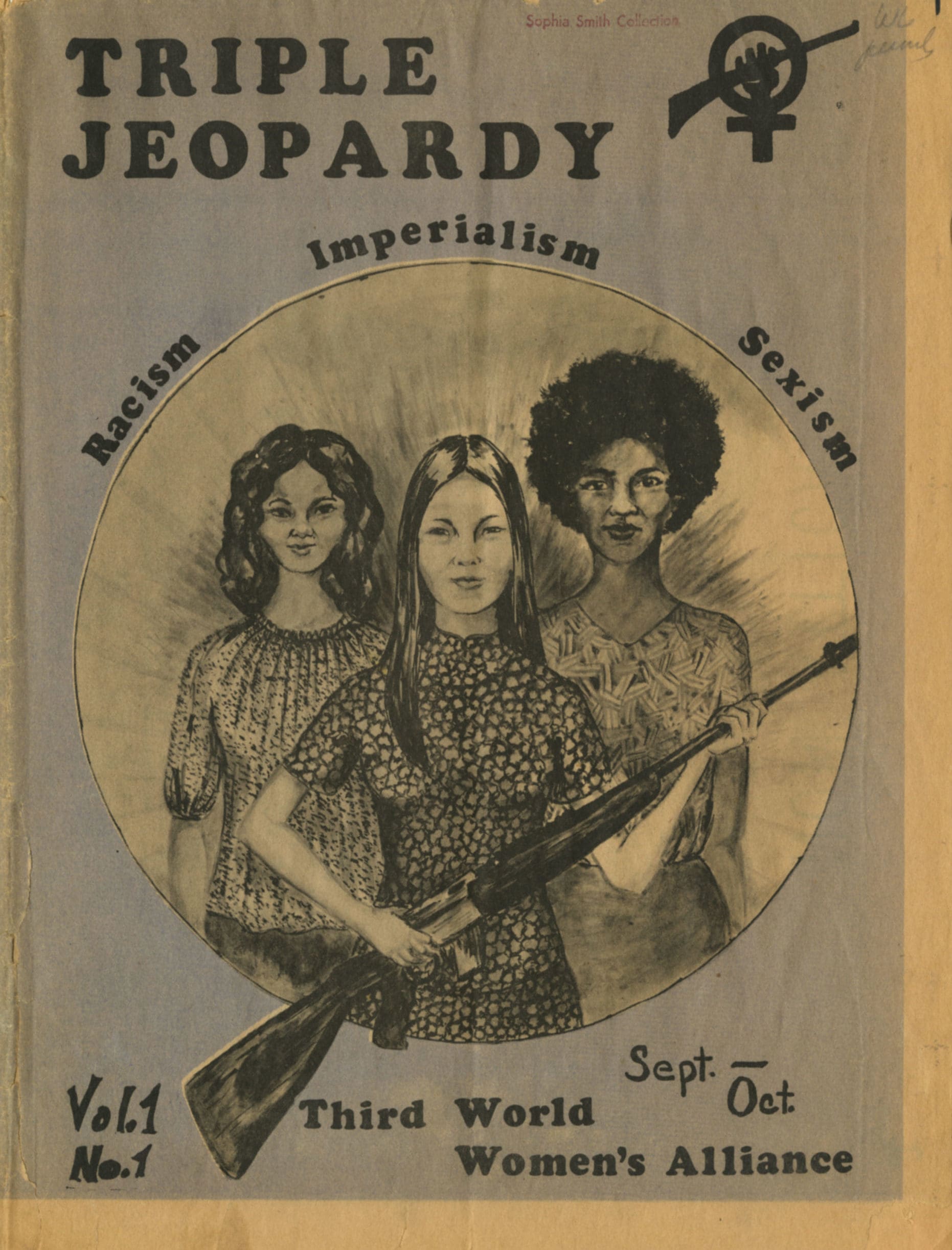
A more recent version of such a consciousness-raising feminist magazine in a decolonial period was Triple Jeopardy,50 created by the Third World Women’s Alliance and running from 1970-75. While far more overt in their political engagement, Triple Jeopardy recalls many categories of the Vietnamese women’s magazines such as issues in domestic life and labor struggles. Voices from the global south and colonized peoples were brought in conversation with their counterparts in the United States.
The reach of these magazines extended into the lives of the women they covered as much as those who read them. It was Phụ nữ Tân văn that first brought public attention to Lê Thị Lựu — announcing her graduation and hailing her as a sign of national progress — and in doing so, placed her at the intersection of feminist print culture and the emerging Vietnamese art world.
Born in 1911, Lê Thị Lựu was a painter and poet who graduated from the l’École des Beaux-Arts de l’Indochine in 1932 — the first woman to do so.51 The 127th issue of Phụ nữ Tân văn, published that April, described her in celebratory terms:
She [Lựu] is still young, very intelligent, innovative, and a top student at school, this June she will graduate likely with a high score: her male colleagues who have all become successful, for example Lê Phỗ [sic], Tô Ngọc Vân, Nguyển Cao Đàm [sic], v. v… all compliment her academic talents, what a pioneering woman within the art world.52
She was framed as a sign of national progress — proof that women could not only appreciate art but train rigorously within the academy.53 The author went further, suggesting that Lê Thị Lựu’s practice uniquely reconciled tình cảm (emotional sensibility) and mỹ cảm (aesthetic sensibility) — qualities seen as present but unresolved in women more broadly.54
In 1940, she moved to France with her husband. While in France, Lê Thị Lựu was part of the L’Union Culturelle des intellectuels de France (The Cultural Union of Intellectuals in France), which supported the ongoing decolonisation movement which persisted after the Declaration of Independence in September 1945. The union believed that ‘only negotiations with the Vietnamese national government, led by President Ho Chi Minh, can bring peace to Vietnam and guarantee French interest on Vietnamese territory.’55 It states:
France’s refusal to negotiate with Ho Chi Minh may be a mistake. The actions of the new government will be closely watched by the left-wing parties, which are already firmly convinced that France has no intention of relinquishing its rule.56
In 1946, the Fontainbleau Conference took place in Paris. Lê Thị Lựu attended the conference, presumably as the Treasurer of the Union, and was photographed seating next to Hồ Chí Minh and Phạm Văn Đồng (who later became the Prime Minister of North Vietnam). In the same year, along with fellow artists Mai Trung Thứ, Vũ Cao Đàm, and Lê Phổ, her paintings painted in France were taken back to Vietnam in a group exhibition supported by the Democratic Republic of Vietnam to celebrate the success of the August Revolution.
Her political commitments carried consequences. On 16 January 1953, she was arrested and detained under a rogatory commission, her arrest was reported by L’Humanité alongside those of numerous other Vietnamese intellectuals, artists, doctors, and scientists in Paris.57 These were part of what the French government termed “measures of suppression” — targeted action against Vietnamese students and intellectuals abroad. She was later released, but the arrest marks the point at which her story, like those of so many others, moves from celebration into erasure.
A Coda
The histories gathered here are marked by what might be called a double — or triple — erasure. These women were first suppressed by colonial and authoritarian regimes that banned their publications, imprisoned their bodies, and removed their names from official records. They were then marginalised within the very revolutionary movements they helped build, their feminist critiques subordinated to nationalist imperatives or quietly excised from commemorative histories. And they were erased again by the disciplinary boundaries of art history, literary studies, and postcolonial scholarship, which have largely treated visual culture, print activism, and political organising as separate histories with separate protagonists.
To recover these figures is not simply to add names to an existing archive — it is to challenge the structural conditions that made their disappearance possible, and to ask what other histories remain, still waiting to be read together. What does it mean to reconstruct histories that were deliberately fragmented? Can placing Sedar in Bandung and Nữ giới Chung in Saigon on the same temporal axis — making their simultaneity visible — begin to restore connections that suppression severed? When the timeline reveals gaps rather than filling them, can absence itself become a form of argument — unknown dates and missing names registering not as failures of research but as evidence of erasure? And what happens when the form reaches its limits, when histories that are oral, embodied, or cyclical resist the logic of any single temporal spine? These are the questions this project holds open.
Notes
-
Jafar Suryomenggolo, “Introduction: Rereading Leftist Writings from Southeast Asia,” in Rereading Leftist Writings from Southeast Asia, edited by Jafar Suryomenggolo, special issue, Southeast Asian Studies 7, no. 1 (April 2018): pp. 3-11 and Sophie Quinn-Judge, “Women in the early Vietnamese communist movement: sex, lies and liberation,” South East Asia Research 9, no. 3 (2001): pp. 245–269; see as well Sophie Quinn-Judge, Ho Chi Minh: The missing years, 1919-1941 (Berkeley: University of California Press, 2002). ↩︎
-
Quinn-Judge, “Women in the early Vietnamese communist movement,” pp. 245–269. ↩︎
-
Ibid. ↩︎
-
Saskia Wieringa, Sexual Politics in Indonesia (New York: Palgrave Macmillan, 2002), pp. 301-317. See Field Notes for Astrid Reza’s reflections on the current process of re-reading Api Kartini by Indonesian scholars and artists has become a process of retracing the “exiled” archives, which are hardly accessible to Indonesians themselves, especially in Indonesia. Along with the ongoing instilled fear of these considered forbidden materials. ↩︎
-
Recently the two only remaining paintings of Siti Halimah resurfaced in the newly found archive of Api Kartini (No. 12, 1961). In the article written by Sjaraswati, Siti Halimah stated that she had been painting since 1949, but her father did not approve and she stopped for 10 years before she resumed. It is also mentioned that she wrote fiction. Halimah was a member of Sanggar Pelukis Rakyat (which Mia Bustam stated in her personal writing on A. Dermawan T. books that its member also belong to LEKRA), she went missing until now (most probably killed) along with the well known leftist artist Trubus (1926-1966) in the turmoil of communist purge after 1st October 1965. ↩︎
-
This was briefly explored in Heidi Arbuckle, “Performing Emiria Sunassa: Reframing the Female Subject in Post/colonial Indonesia,” (unpublished PhD Thesis, University of Melbourne, 2011); and Wulan Dirgantoro, Feminisms and Contemporary Art in Indonesia: Defining Experiences (1st ed. Amsterdam: Amsterdam University Press, 2017). ↩︎
-
One method undertaken was oral history and the use of a biographical approach. See Susan Blackburn and Helen Ting (ed.), Women in Southeast Asian Nationalist Movements: A Biographical Approach (Singapore: NUS Press, 2013). Also see Susan Blackburn, Women and the State in Modern Indonesia (1st ed. Cambridge: Cambridge University Press, 2004). ↩︎
-
Show Ying Xin, “Gendering Chinese diaspora: New Women’s Monthly and transnational sisterhood in postwar Malaya,” Inter-Asia Cultural Studies 24, no. 4 (2023): pp. 625-642. ↩︎
-
Ina Zhang, “A dissenting voice: The politics of Han Suyin’s literary activities in late colonial and postcolonial Malaya and Singapore,” Journal of Postcolonial Writing 57, no. 2 (2021): p. 160. Han’s definition of Malayan literature was deliberately inclusive: works written in any of the four language streams — Malay, Chinese, Tamil, or English — should be recognised as part of a single literary tradition, insofar as they related by “emotion, identification, description, social content and involvement” to Malaya and Singapore. Publicly, she called for an end to the “senseless persecution” of Chinese writers, urging governments in the Federation and Singapore to allow space for creative development. ↩︎
-
See for instance Loh Kah Seng, “Polytechnicians and Technocrats: Sources, Limits, and Possibilities of Student Activism in 1970s Singapore,” in Rereading Leftist Writings from Southeast Asia, edited by Jafar Suryomenggolo, special issue, Southeast Asian Studies 7, no. 1 (April 2018): pp. 39-63. ↩︎
-
Show, “Gendering Chinese Diaspora,” pp. 625-642. ↩︎
-
Ina Zhang, “A dissenting voice: The politics of Han Suyin’s literary activities in late colonial and postcolonial Malaya and Singapore,” Journal of Postcolonial Writing 57, no. 2 (2021): pp. 155-170, and Feng Cui and Alex Tickell, “Han Suyin: The little voice of decolonizing Asia,” Journal of Postcolonial Writing 57, no. 2 (2021): pp. 147-153. ↩︎
-
Ibid. ↩︎
-
Grace V.S. Chin, “Malayan Chinese women in a time of war: Gender, narration, and subversion in Han Suyin’s And the Rain My Drink,” Journal of Postcolonial Writing 57, no. 2 (2021): pp. 269-281. ↩︎
-
Ibid. ↩︎
-
This is observed in detail in Show, “Gendering Chinese Diaspora,” pp. 634–35. ↩︎
-
Show Ying Xin notes that although Khatijah did not mention the meeting with Shen in her memoir, she did reference a ‘great misunderstanding on many things between Malays and Chinese, due to British and Japanese policies. See Khatijah Sidek, Memoir Khatijah Sidek: Puteri Kesateria Bangsa (Bangi: Penerbit UKM, 2001), p. 72. ↩︎
-
Battling against the conservative leaning views of UMNO, she became a controversial figure–her proposal to establish women’s organisation Kesatuan Wanita was rejected–and Sidek was eventually expelled from the party in 1956. Following this, joined PAS, where, under her leadership, membership of Dewan Muslimat, PAS’s women’s branch, rose from 3,000 in 1963 to 8,500 in 1966. In 1972, Sidek rejoined UMNO in 1972 as a regular party member. Sidek passed away in 1982. ↩︎
-
See Stefanie Tham, “The Equator Art Society in Singapore, 1956-74,” (Unpublished BA Hons Thesis, National University of Singapore: Department of History, 2012). ↩︎
-
Tham, “The Equator Art Society,” - see especially Chapter 2: "The Equator Art Society and the People’s Action Party, 1959-1961. ↩︎
-
Ibid, Chapter 2. ↩︎
-
For example Lee Boon Ngan too partook in EAS activities, and later married co-founder Chua Mia Tee. See Yvonne Low, “Lee Boon Ngan,” [A biography produced as part of the programme The Flow of History, Southeast Asian Women Artists, in collaboration with Asia Art Archive], Archives of Women Artists Research and Exhibitions, https://awarewomenartists.com/en/artiste/lee-boon-ngan/. Last accessed 4 March 2026. ↩︎
-
Tham, “The Equator Art Society", 24. ↩︎
-
Ibid, p. 24, 33. Author highlighted how the Ministry of Culture even included the EAS on the organizing team for the first National Day art exhibition in June 1960, and the Deputy Prime Minister Dr. Toh Chin Chye attended their events. ↩︎
-
Ibid. The author asserts that the government saw this as confirmation of what they had long suspected: the EAS was part of the communist conspiracy. The Internal Security Department had classified the EAS as “a front organisation involved in the [communist] movement.” The headquarters was sealed up, the sixth exhibition was stopped and members were arrested with some sent to China and barred from re-entering Singapore. ↩︎
-
Ibid. The author asserts that the government saw this as confirmation of what they had long suspected: the EAS was part of the communist conspiracy. The Internal Security Department had classified the EAS as “a front organisation involved in the [communist] movement.” The headquarters was sealed up, the sixth exhibition was stopped and members were arrested with some sent to China and barred from re-entering Singapore. ↩︎
-
Although the early critic from Saskia Wieringa regarding that Api Kartini consider to be for middle class/elite women reader and mean to be a popular media. While Berita Gerwani is more for internal members of Gerwani but mainly for their grassroots women cadre. ↩︎
-
Editorial Api Kartini, No. 1 Thn. 1, 1959. ↩︎
-
See Joss Wibisono essay on the argument of how the early translation of Kartini letters from Dutch to Indonesian were problematic and deliberately choosen words to make her words “deradicalized”: https://gatholotjo.com/2017/08/13/betapa-kartini-telah-terdjinakkan-oleh-joss-wibisono/ ↩︎
-
See Decolonizing the Myth of Kartini by Saut Situmorang on recent critic of Kartini role as an “acceptable” feminist icon by the colonial government: https://recalibrate.nl/decolonising-the-myth-of-kartini ↩︎
-
Sitisoemandari Soeroto, Kartini: Sebuah Biografi (Jakarta: PT Gunung Agung, 1977), pp. 433-435. ↩︎
-
The three paintings made around early 1900s (“Taman Kembang Leli” - Kartini, “Pantai Djepara” - Rukmini, “Tiga Ekor Kucing” - Kardinah) went missing in 1965 turbulence, after being given as a gift to the Education and Cultural Minister, Dr. Prijono in 9th May 1964. Dr. Prijono kidnapped four days after Soeharto rise into power, on 16th March 1966 by the pro New Order students. Prijono was indicated to be a socialist and pro-Soekarno, and was taken to The Army Strategic Reserve Command (KOSTRAD). He died four years later on 6th March 1969 from a sudden heart attack. ↩︎
-
Only in recent years have digital copies begun to emerge from overseas repositories, with some issues now appearing in the National Library and a local library in Yogyakarta. This research has so far recovered approximately half of the complete publication run, with many issues still missing, perhaps destroyed, perhaps still hiding in collections yet unknown. ↩︎
-
Sugiarti Siwadi, “Mia Bustam: Ketua Rukun Tetangga-tetangganya Pelukis-pelukis Djokja,” Api Kartini, no. 10 Thn II 1960, 3 - 5 ↩︎
-
Mia Bustam Archive and Exhibition recently held in Vrederburg Fort, Yogyakarta, Indonesia during the Biennale Jogja 18 event, 5th October 2025 - 20 November 2025. ↩︎
-
Dian Astrid Widjaja, “Mia Bustam’s Memoir: Transcending Leftist Melancholy” (Unpublished thesis, Sanata Dharma University, 2025), p. 57. ↩︎
-
Yerry Wirawan, “Independent Woman in Postcolonial Indonesia: Rereading the Works of Rukiah,” in Rereading Leftist Writings from Southeast Asia, edited by Jafar Suryomenggolo, special issue, Southeast Asian Studies 7, no. 1 (April 2018): p. 96, 99. ↩︎
-
Wirawan, “Independent Woman,” p. 94. ↩︎
-
Her husband Sidik Kertapati, a member of the parliament from the Indonesian Communist Party, was exiled while visiting China during the purges of October 1965. They never met again. ↩︎
-
Mirat Kolektif, Catatan dari Sana Sini: Catatan Proses Pertunjukan dan Pameran Sudut Hati Terpercik Api (Mirat Kolektif, 2025). This digital publication can be accessed through: http://bit.ly/catatandarisanasini. Their recent reading and theatre performance transformed these once-unknown editors into figures a Gen Z audience could encounter directly — rendered as a puzzle, pieced together from the fragments of a suppressed archive. ↩︎
-
The word “sedar” being used from time to time, rooting from the Malay root, it means “aware”, conscious, feeling and knowing. “Wanita Sedar” means "Conscious Women”. ↩︎
-
Importantly, this magazine marks a transition from Confucian domestic ideology to public discourse. ↩︎
-
They are: Editorial (Xã thuyết; article de fond), Vocational Studies (Học nghệ; métiers), Domestic Management (Gia chánh; ménage), Literary Garden (Văn uyển; variété littéraire), Miscellany (Tạp trở; faits divers), Current Affairs (Thời đàm; chronique), Biographies (Truyện ký; contes), and Fiction (Tiểu thuyết). ↩︎
-
The Trưng Sisters and Lady Triệu are renowned Vietnamese heroines who led resistance movements against foreign domination. Notably, historical accounts indicate that one of the Trưng Sisters ascended the throne and proclaimed herself queen while her husband, Thi, was still alive. However, later historians revised this detail, asserting instead that she rose to power in order to avenge her husband, who was said to have been killed by Tô Định, the Han dynasty governor (from China). ↩︎
-
AOM, SPCE 385, Envoi no. 92 of 21 April 1933 of Service de Renseignements, Shanghai; translation of two letters in quoc-ngu sent from Hong Kong, 7 February 1933 by Nguyễn Thị Minh Khai to Nanjing. ↩︎
-
Most issues available through Vietnam’s National Library: http://baochi.nlv.gov.vn ↩︎
-
David G. Marr, Vietnamese Tradition on Trial, 1920-1945 (Berkeley: University of California Press, 1981). ↩︎
-
Marr, David. “The 1920s Women’s Rights Debates in Vietnam.” The Journal of Asian Studies, vol. 35, no. 3, 1976, pp. 371–89. JSTOR, https://doi.org/10.2307/2053270. Accessed 4 Mar. 2026. ↩︎
-
Original text: Kinh-nghiệm lịch-sử chứng minh rằng: tự-do dân-chũ tư-bãn không phải là cái cũa hết thảy moiuj [sic] người; phụ-nữ giải-phóng cũa phái phụ-nữ tư-sãn không phải là cuộc vận-động giải-phóng cho chung cho hết thảy các lớp phụ-nữ.
Translation by: Hương Ngô, Tin Lê, Nguyễn Thị Minh, Hoàng Phuong Mai, and Yến Lê Nguyễn. ↩︎ -
“Danh sách sinh viên các khoá của Trường Cao Đẳng Mỹ Thuật Đông Dương,” Trường Đại học Mỹ thuật Hà Nội: 1925-1990 (NXB Mỹ thuật, 1992), 49. ↩︎
-
Original text: Cô còn nhỏ tuổi, rất thông minh, có sáng-kiến, ở trong trường học vẩn là tay cao-đệ, tháng sáu năm nay thì ra, chắc cô đậu cao: bạn trai đồng học, nay đã thành tài rồi, như các ông Lê-Phỗ, Tô-ngọc-Vân, Nguyển-cao-Đàm, v. v… cũng đều khen cái tài học của cô, thật là một người nữ-tên-phong trong mỷ-thuật-giới. Phụ Nữ Tân Văn, Số 127, 14 Tháng Tư 1932. ↩︎
-
“It is said that progress is an art form, proving that if one wants progress, one must appreciate art. I have observed that many of our people have now understood and appreciated the arts, that is a good sign. I have also observed amongst our sisters who have also loved art, this is all the more encouraging.” (translated from original text: Người ta nói sự tiến-bộ là một mỷ-thuật, đủ chứng tỏ ra rằng nếu người muốn tiến-bộ thì phải biết trọng mỷ-thuật mới được. Tôi thấy bây giờ đồng-bào đã có nhiều người biết xu hướng và yêu mến mỷ-thuật, ấy là cái dấu tỏ đáng mừng. Lại thấy một vài chị em cũng xu-hướng và yêu mến mỷ-thuật, thì càng đáng mừng hơn nữa.) ↩︎
-
Aside from a very brief mention of Mộng Hoa (Maria Mộng Hoa?). Not a lot of research have been done on her as another woman artist, who predominantly practice in central Vietnam. Her studio was allegedly near the Imperial Palace in Hue, and she exhibited regularly within the central region. (https://baodanang.vn/nu-hoa-si-dau-tien-dat-da-thanh-3028328.html) ↩︎
-
Original text: L’Union Culturelle des intellectuels de France dont nous publions ci-dessous la liste estime que “seules des négociations avec le Gouvernement national Vietnamien que dirige le Président Ho Chi Minh sont capables de ramaner la paix au Vietnam et de garantir les intérêts francais en territoire Vietnamien. Nouvelles de l’Union Française: Le Conflit Franco-Vietnamien,” Soudan-Niger: Organe officiel du Parti progressiste Soudanais, 01 Septembre 1948. ↩︎
-
Ibid ↩︎
-
Original text: Six vietnamiens arrêtes le 16 Janvier dont Madame Le Thi Luu ont été remis en liberte. Paris. – Dans les milieux informés, on précise que les six vietnamiens des Paris dont nous avons signalé l’arrestation le 16 janvier, le furent sur commission rogatoire à propos d’une affaire judiciare en cours. Après l’interrogatoire, ils furent remis en liberte. “Nouvelle arrestations de Vietnamiens à Paris,” L’Humanité: Journal Socialiste Quotidien, 15 Janvier 1953. ↩︎